From Prompt to Profit: A Workflow for Producing Commercial AI Music
A practical workflow for turning AI music tools into a production pipeline that makes real money.
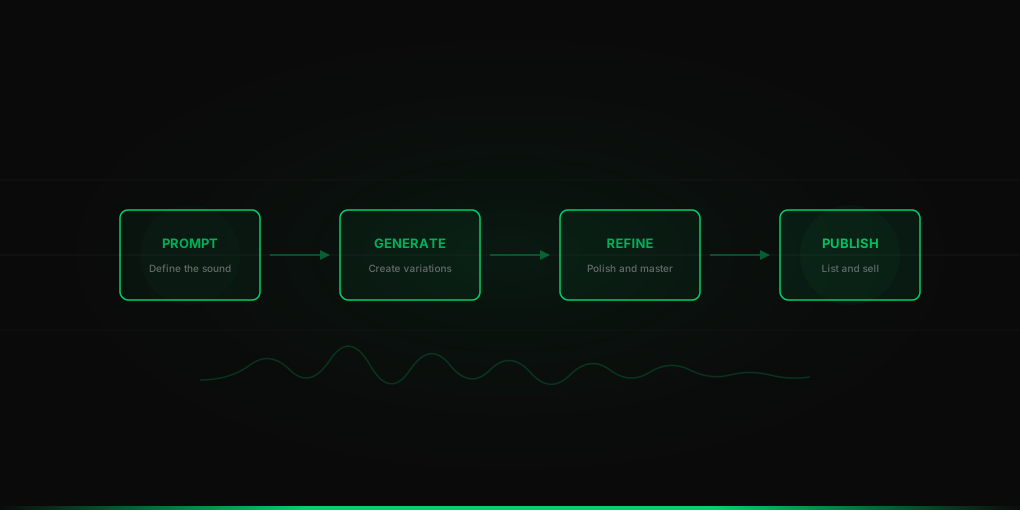
Anyone can generate a track with AI in a few minutes. But generating a track and producing something a buyer will actually pay for are two very different things. The gap between them is your workflow.
The Gap Between Generating and Selling
Most AI music that never sells has the same problem — it was generated, not produced. The creator typed a prompt, got a result, uploaded it, and moved on. No iteration, no refinement, no thought about who would actually use it.
Commercial-ready music requires a production mindset. You’re not just creating sound — you’re creating a product. And products need a process behind them.
Start With the Use Case, Not the Prompt
Before you open any AI music tool, ask yourself: who is this track for?
A podcast intro has completely different requirements than background music for a mobile game. A YouTube outro needs a different energy than a brand campaign anthem. When you start with the end use in mind, every decision that follows gets easier — your prompt, your length, your arrangement, your tags.
Think about it this way:
- Podcast intros — short, distinctive, recognizable after a few listens
- Background music — neutral enough to sit behind dialogue, consistent mood
- Ad/campaign music — emotional arc in 30-60 seconds, strong hook
- Game environments — loopable, atmospheric, non-intrusive
The more specific your target, the more useful your output.
Iterate, Don’t Settle
The first generation is almost never the one you should upload. Treat it as a starting point. Run the same concept through multiple prompts. Adjust the mood, the tempo, the instrumentation. Compare five or ten variations and pick the strongest one.
This is where the craft lives. AI gives you speed — use that speed to explore more options, not to ship faster. The creators who generate ten versions and pick the best one will always outperform the ones who generate once and move on.
Post-Production Still Matters
Even after you’ve picked your best generation, the work isn’t done. Commercial music needs to sound polished. That means:
- Trim the beginning and end — clean starts and fades matter more than you think
- Check the levels — make sure the track isn’t clipping or too quiet relative to commercial standards
- Light mastering — even basic EQ and compression can bring a track from “pretty good” to “ready to sell”
- Listen on multiple devices — what sounds great on studio monitors might sound muddy on laptop speakers
You don’t need a professional studio. A basic DAW and a pair of decent headphones will get you most of the way there.
Metadata Is Half the Job
Here’s the part most creators skip — and it costs them sales. Your track’s title, description, tags, and mood labels are what make it discoverable. A buyer searching for “upbeat electronic workout music” will never find your track if you titled it “Track_47_final” with no tags.
Write titles that describe the feeling, not the technical specs. Tag every relevant mood, genre, and use case. Write a one-sentence description that tells a buyer exactly what they’re getting.
When you’re ready, list your tracks on a marketplace like Cambrian — metadata is how buyers find you. A great track with bad metadata is invisible. A good track with great metadata will outsell it every time.
The workflow that turns prompts into profit isn’t complicated — it just requires treating every step with intention. Define the use case, iterate on the generation, polish the output, and make it findable. Do that consistently, and the sales follow.
Stay in the loop
New posts, creator spotlights, and releases — no spam.
Ready to build your audience? Start on Cambrian →